
I’ve lost count of the launches we’ve watched go sideways, and honestly, it’s rarely the code. Usually the problem is simpler and a bit more painful. Nobody outside the founders’ Telegram knew the date, or the few hundred people who did show up got bored by Thursday.
So when people ask us about token launch marketing, we don’t start with ads or influencers. We start with the calendar. What follows is roughly the plan we walk new crypto clients through, minus the fluff, so a team of three can actually run it.
All the stuff that gets people to hear about your token, get what it does, and trust you enough to stick around. Community, content, a bit of PR, paid ads if you’re allowed to run them. It starts well before launch day and (this is the part teams forget) carries on for months after it.
We had one rule drilled into us early: the launch isn’t the finish line. In the projects we’ve supported, the ones still buzzing three months later are almost always the ones where someone kept posting updates and answering dumb questions long after the listing. The ones that went silent? Their Discord turned into a ghost town pretty fast.
Quick history lesson if you’re newer to crypto. Wikipedia’s write-up on the initial coin offering boom is worth a skim. A lot of the distrust you’ll run into today traces straight back to 2017, when hype was cheap and follow-through wasn’t.
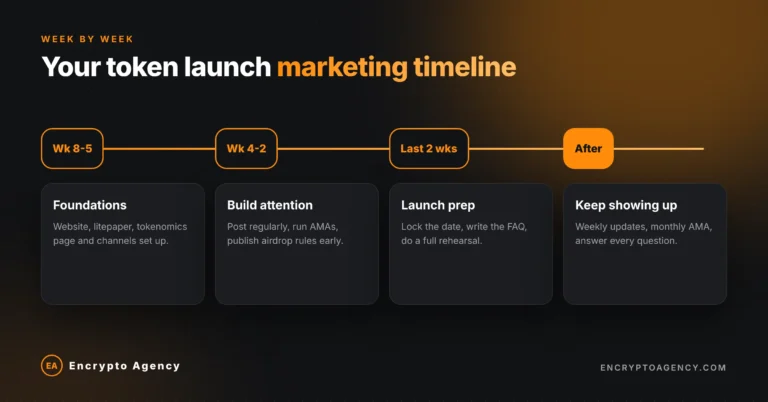
Six to eight weeks out, ideally. Less than that and you’re squeezing community building, content and press into a panic window, and people notice the panic. We’ve had teams come to us ten days before launch. We still helped. It just wasn’t fun for anyone.
Here’s how we tend to carve up that time.
Get the website done. Same for the litepaper and a tokenomics page a normal person could follow. If your tokenomics need a whiteboard and twenty minutes to explain, simplify them or at least the explanation.
Then pick your channels. For most projects that’s X plus either Telegram or Discord, sometimes both. And decide, by name, who answers questions in there. An empty channel is bad. A busy channel where nobody from the team replies is worse.
This is where you post. Regularly, not in bursts. Talk about the problem you’re solving, show the team if you can, share progress even when it’s small. We like AMAs here because people get to ask the uncomfortable stuff out loud, and how you handle it says more than any polished graphic.
Planning an airdrop or whitelist? Publish the rules early and keep them short. Nothing fills a mod’s inbox faster than confusing eligibility criteria.
Because it is. Lock the date, double-check exchange or DEX details, write the announcement posts, write the FAQ, brief whoever’s on support duty. Then run through the whole thing once like it’s real. Broken links on launch day are weirdly common.
Wherever your actual audience already hangs out, which sounds obvious but gets ignored constantly. A DeFi protocol and a play-to-earn game aren’t fishing in the same pond. Community channels usually carry most of the weight, with content, PR and (sometimes) paid ads helping around the edges.
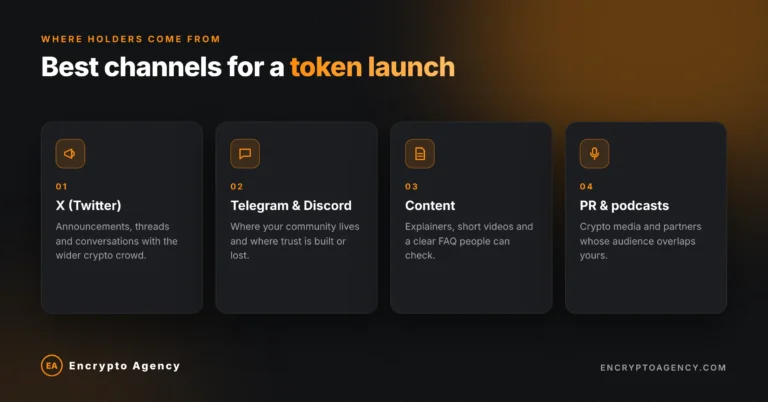
In our experience X does the announcing and the arguing. Telegram or Discord is where trust gets built, or quietly lost. Long-form content, like explainers, short videos and a proper FAQ, lets the careful buyers check your homework on their own time. And PR or partnerships with crypto podcasts and media, plus other projects whose audience overlaps yours, can get you in front of people who’d never stumble across you otherwise.
Don’t sleep on Reddit either, though tread carefully. Subs like r/CryptoCurrency can smell a shill from a mile off. Lurk first. Read threads about launches like yours, write down every doubt people raise, and answer those doubts in your own FAQ. Posting your token link there on day one is a great way to get roasted.
Running all of this daily is a real job, which is partly why we offer crypto community management
Sometimes. Google and Meta both allow some crypto advertising, but there are hoops: certification, written permission, specific countries only, certain products not at all. Read the rules for every platform and market before you build a budget that assumes ads will run.
Google spells out its side in the cryptocurrencies and related products policy, including which countries certification covers. Meta’s version is the cryptocurrency products and services policy for Facebook and Instagram. Both change every so often. Re-read them a week or two before launch, not just when you first plan.
There’s a longer breakdown in our post on crypto ads on Google and Meta if you want the detail.
Price predictions, for a start. “100x incoming” might get likes, but it also gets ads rejected and makes serious people back away slowly. Same goes for anything that sounds like guaranteed returns.
Bought followers and bot replies come up a lot too. They look fine for about a day, then someone runs your account through a checker and posts the screenshot. Influencers who don’t disclose paid posts are a similar story, just slower.
Then there’s the post-launch slump. Everyone’s exhausted, the team takes a week off, and the community reads silence as a red flag. Plan for it. Someone has to be on.
One honest caveat, since we’d rather say it than have you find out the hard way: marketing can’t save a weak project. It can get a good one in front of the right people and make it easy to understand. That’s about it.
None of this is glamorous. It’s mostly consistency, clear writing and a bit of patience. But launches built this way tend to keep their people. If you’d like us to look over your plan before the date’s locked in, drop us a message
EnCrypto Agency is a Web3 and blockchain solutions provider specializing in cryptocurrency exchange and wallet development, smart contracts, dApps, DeFi solutions, crypto business licensing, and crypto ads approval. The team provides end-to-end support for startups, crypto businesses, and Web3 projects, from development and compliance to launch and growth.