
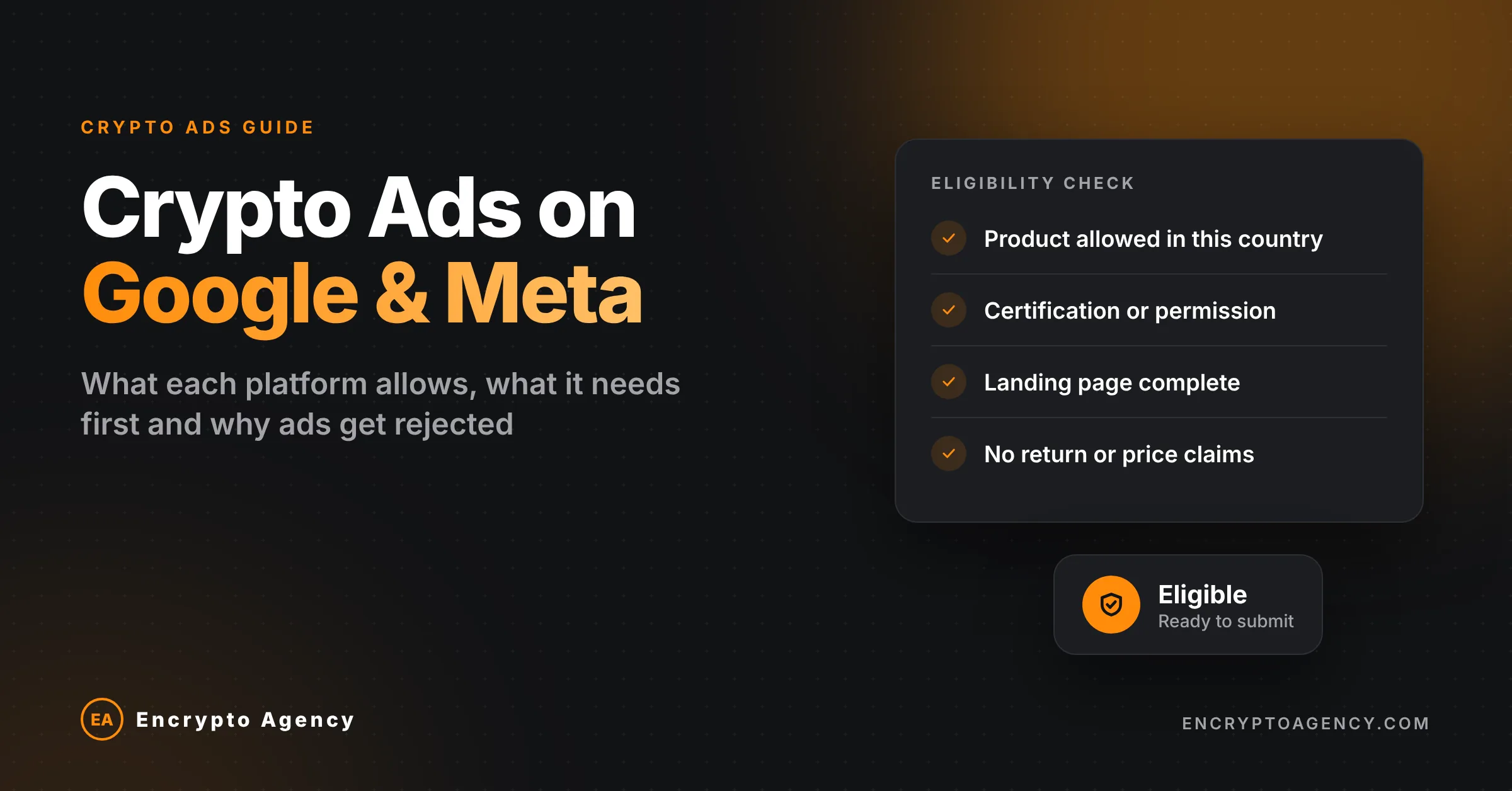
Short answer, yes. Longer answer, yes, but with enough conditions attached that plenty of projects get it wrong the first time.
It’s probably the question we hear most from crypto founders. Usually it comes with a screenshot of a rejected ad and a slightly exasperated “why?”. So let’s go through what Google and Meta will actually let you do, what they want to see before they’ll say yes, and where projects tend to trip up.
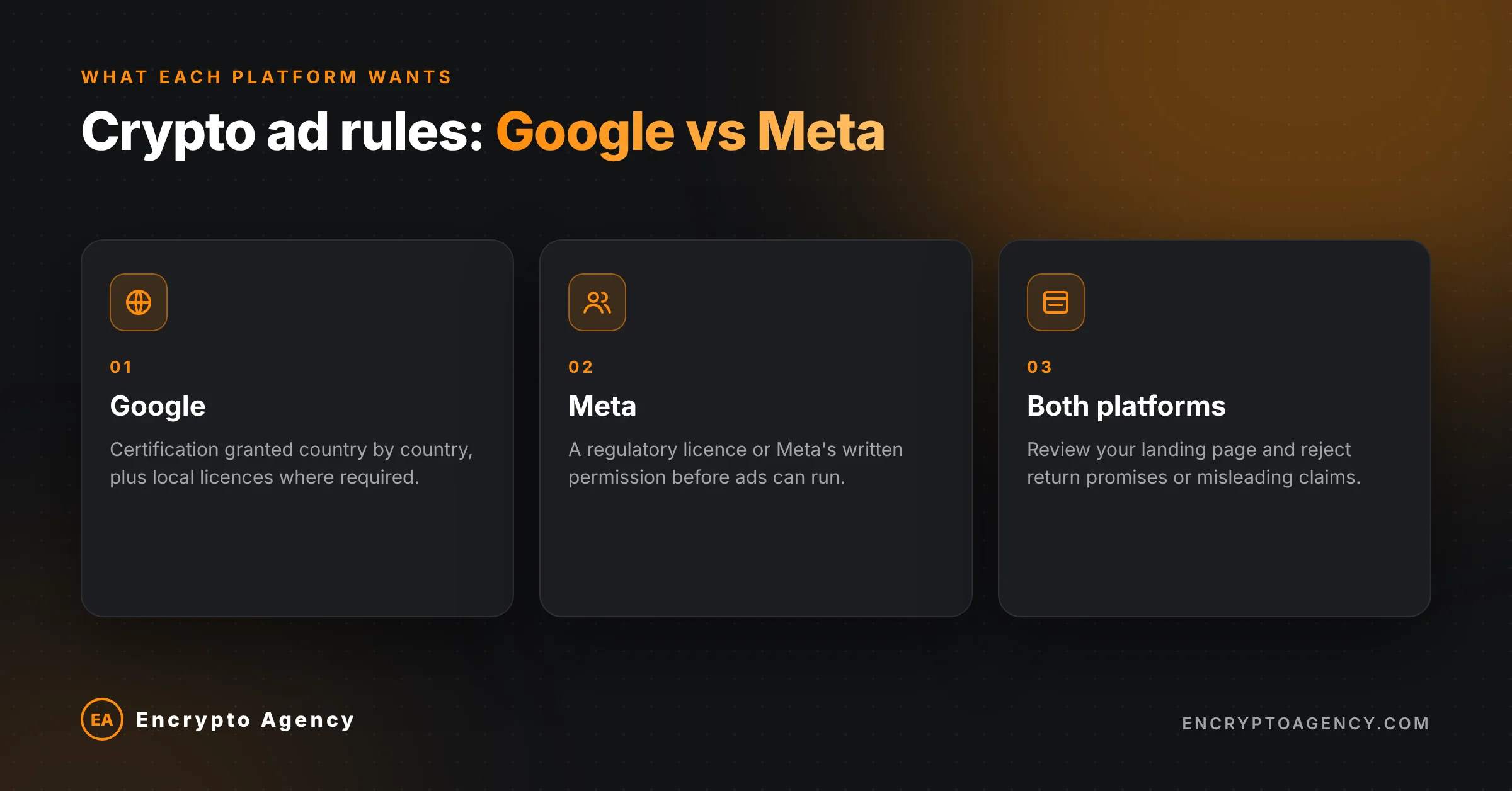
They are, for some products and in some countries, and usually only once you’re certified. Google’s rules cover things like exchanges and software wallets, and they lean heavily on local law. Translation: if a country wants you licensed or registered, Google wants proof of that before your ads run there.
Everything lives in Google’s cryptocurrencies and related products policy. It’s not a thrilling read, but it does list the countries where certification is possible and what each one requires. Go through every market you’re thinking about. They differ more than you’d expect, and a setup that’s fine in one place can be flat out unavailable next door.
Three things catch people out more than anything else. Certification is country by country, so being approved in one market doesn’t carry over. Product type matters a lot, too. A hardware wallet shop and an NFT game aren’t judged the same way. And Google reviews your website, not only the ad.
You apply through Google’s advertising policies help pages, say which country and product type you’re applying for, and send the documents that prove you’re licensed or registered where that’s needed. Then you wait. We can’t give you a firm timeline because there isn’t one, so apply long before you need ads live. Use the waiting time well. It’s the perfect moment to fix the website and draft a few versions of your ad copy.
Meta lets some crypto ads run on Facebook and Instagram, but you’ll typically need either the right regulatory licence or written permission from Meta first. Skip that step and your ads get rejected, and if you keep trying the account itself can get flagged.
Details are in Meta’s cryptocurrency products and services policy. Honestly, the most common thing we see in accounts we take over is someone launching a campaign before sorting eligibility, then spending two weeks wondering why everything’s stuck in review.
Targeting is part of it as well. Crypto ads generally can’t reach under-18s, and certain regions pile on extra rules. Check before you build audiences, and jot down what you targeted in case a reviewer asks later.
ually it’s one of four things. You’re not certified or approved yet. The product isn’t eligible in that country. The ad says something misleading or over the top. Or the landing page is thin, vague, or doesn’t match what the ad promised. Work out which one it is before touching the ad, because rewording rarely fixes an eligibility problem.
Claims are a bigger deal than most people think. “Guaranteed returns”, “double your money”, “risk-free”… all of those run straight into Google’s misrepresentation policy, and Meta has its own version. Serious buyers find that language a bit off-putting anyway, so you’re losing on two fronts.
Landing pages are the other usual suspect. A reviewer should be able to work out fairly quickly who runs the project and how to reach them, what the product does, and where the terms, privacy policy and any licence details live. Risk wording helps too, where it applies. If your homepage is a countdown clock and one big Buy button, you’re asking for trouble. We’ve watched perfectly decent ads sit in limbo for weeks because the site behind them looked thrown together in an afternoon.
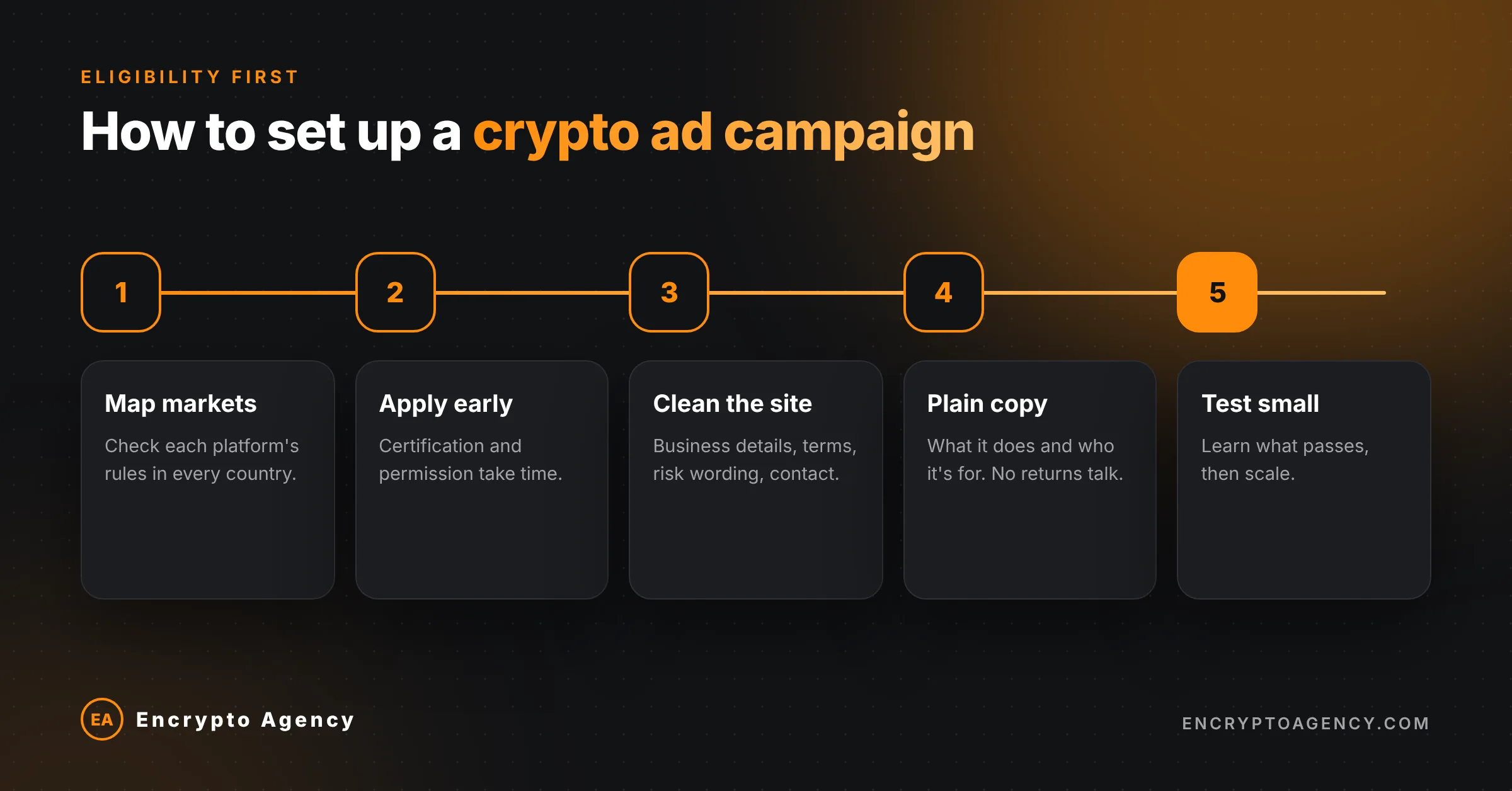
Eligibility first, creative last. Find out which platforms and countries allow your product, apply for whatever certification or permission you need, fix up the website, and only then start writing ads. When you do, lean into education and genuine usefulness rather than price talk.
The order we follow goes something like this. Map your markets and check each platform’s rules country by country. Apply early, since both Google certification and Meta permission take time and launch week is too late. Tidy the site so business details, terms and contact info are easy to find.
After that, write the copy plainly. What does the product do? Who’s it for? Leave out returns and fake urgency. Start with a small budget, see what gets through review, adjust, then scale. Oh, and keep every certification email, licence document and review notice in one folder. If you ever need to appeal, you’ll be glad you did.
If the ads are part of a bigger launch, our token launch marketing plan shows how paid fits in with community, content and PR.
Some projects won’t qualify, at least not yet. That’s frustrating, but it’s not the end of the road. Community, content, PR, partnerships and organic social can all still bring in people who care about what you’re building.
We’d go further, actually. For early-stage projects those channels often beat paid ads. Ads are good at scaling something people already like. They’re not much good at creating trust from scratch. If you need to explain the basics to someone on your team who isn’t from crypto, Wikipedia’s cryptocurrency article is a decent place to point them.
Please don’t try to sneak ads through by disguising what you’re selling, though. Both platforms treat that as a serious violation, and losing your ad account entirely is a lot worse than not having ads for a while.
It’s more paperwork than most founders expect, but projects that do it properly tend to have a much easier time once ads are live. Want a hand figuring out what’s realistic for you? Our crypto ad team can look over your setup, or just get in touch
EnCrypto Agency is a Web3 and blockchain solutions provider specializing in cryptocurrency exchange and wallet development, smart contracts, dApps, DeFi solutions, crypto business licensing, and crypto ads approval. The team provides end-to-end support for startups, crypto businesses, and Web3 projects, from development and compliance to launch and growth.